Japan Knife TOKU | HHow to Choose Your First Japanese Kitchen Knife: A Beginner’s Guide [2026]
Hello, I’m Tomoaki Okudaira, owner of Japan Knife TOKU.
Our specialty knife shop is located in Asakusa, Tokyo, where we sell Japanese kitchen knives made by skilled craftsmen from Sakai, Osaka, and other regions of Japan. We also offer professional knife sharpening, repair, and sharpening classes.
Kitchen knives are something we use every day, but when it comes time to buy one, many people wonder, “Which knife should I choose?”
In this guide, I’ll explain how to choose the right Japanese kitchen knife, especially if you are buying one for the first time.
The Best First Knife: A Santoku Knife
If you are buying your first kitchen knife, I recommend starting with a Santoku knife.
The Santoku knife is a Japanese all-purpose kitchen knife that became popular in Japan during the Showa era.
It was developed as an all-purpose knife for Japanese home kitchens and can be used for a wide range of ingredients, including meat, fish, and vegetables.
Although the Santoku was developed in Japan, its versatility and ease of use have made it popular around the world. Today, it is commonly known simply as a “Santoku” in many countries.
How to Choose a Santoku Knife
Blade length:
The most common blade lengths are around 165mm to 180mm (6.5 to 7 inches).
If you often cut large ingredients, such as a whole head of cabbage, a 180mm blade is a good choice.
If you mainly cut smaller ingredients and do not often work with large vegetables, a 165mm blade should be more than sufficient.
Handle Shape and Material
Many Santoku knives for home use have handles made from laminated reinforced wood, which is compressed wood stabilized with resin and secured with rivets.
There are also handles designed to fit comfortably in the hand, including shapes such as oval and 10-sided handles.
Another popular option, particularly among customers from overseas, is a traditional Japanese-style handle similar to those found on Japanese single-edged knives such as Deba and Yanagiba knives.
These handles may feature round or octagonal shapes made from materials such as magnolia wood, Japanese yew, or rosewood.
Traditional Japanese-style handles are comfortable in the hand and have a distinctive Japanese aesthetic. However, they are often more expensive than knives with laminated reinforced wood handles.
If this is your first Japanese knife, starting with a more affordable knife with a laminated reinforced wood handle is a good option.
What Should Your Second Knife Be?
So, what should you choose if you already own a Santoku knife?
There are two main approaches.
You can either upgrade from your Santoku to a larger, more versatile knife, or you can add another knife that is better suited to specific ingredients and tasks.
Let’s start with the second option, which is particularly practical for home cooks.
A Petty Knife: A Great Second Knife for Home Cooks
A Petty knife is a great choice for your second knife.
Petty knives typically have a blade length of around 120mm to 150mm (4.7 to 6 inches).
Because a Petty knife is smaller and more maneuverable than a Santoku, it is especially convenient for cutting fruit and other small ingredients.
It is also very useful for tasks such as peeling potatoes, where the compact blade gives you excellent control.
A Petty knife can also serve as a temporary substitute when your Santoku is away for sharpening.
A Gyuto: Upgrade from Your Santoku
If you want to upgrade your Santoku rather than simply add a smaller knife, I recommend considering a Gyuto.
Gyuto knives are generally longer than Santoku knives, with 210mm to 240mm (8.3 to 9.4 inches) being common sizes.
There are also longer Gyuto knives, such as 270mm and 300mm models, which are often preferred by professional chefs.
The longer blade of a Gyuto offers several advantages.
It allows you to use a push-cutting technique, which can be particularly useful when finely slicing vegetables such as cabbage. The longer blade can also make it easier to cut large ingredients in a single motion.
Despite the name “Gyuto,” which literally means “beef knife,” it is an all-purpose kitchen knife that can be used for meat, fish, and vegetables. Outside Japan, Gyuto knives are often referred to as Japanese chef’s knives.
Petty knives are often shaped like smaller versions of Gyuto knives and can also be used as versatile all-purpose knives.
What About Knife Steel?
The material and type of steel used for a kitchen knife affect more than just its cutting performance.
Steel also influences factors such as rust resistance and ease of maintenance.
There are many different types of Japanese knife steel, and I will cover the differences in more detail in a separate article.
Choosing the Right Japanese Kitchen Knife
So far, we have looked at how to choose three versatile all-purpose knives: the Santoku, Petty, and Gyuto.
I hope this gives you a better idea of where to start.
Of course, there are many other types of Japanese kitchen knives, including Deba, Yanagiba, Usuba, Funayuki, and Mioroshi knives.
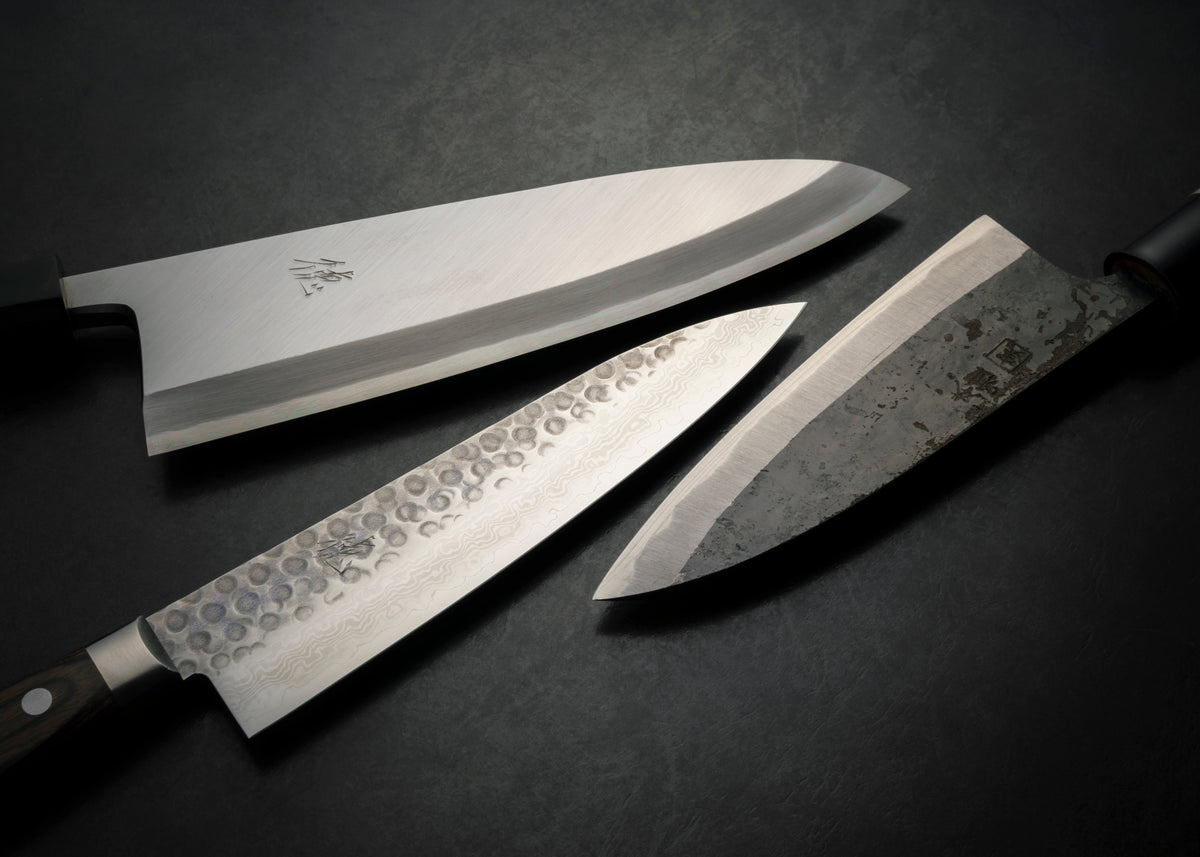
When choosing a kitchen knife, consider what ingredients you will be cutting, the type of steel, the shape and material of the handle, the weight of the knife, and the blade design, such as Damascus or hammered finishes.
Whenever possible, I recommend visiting a specialty knife shop and actually holding the knives in your hand before making your choice. A knife that feels comfortable and natural in your hand is an important part of finding the right knife for you.
If there is no specialty knife shop near you, buying online is another option.
If you contact us by email or phone, we are happy to help you choose the right knife, even if you are purchasing online.
About Japan Knife TOKU in Asakusa
Japan Knife TOKU is a specialty Japanese kitchen knife shop located in Asakusa, Tokyo.
- A wide selection of knives for home cooks and professional chefs
- Personal advice to help you choose the right knife
- Professional sharpening, repairs, and handle replacement
- Knife sharpening classes and hands-on experiences
We believe our job does not end when you purchase a knife. We are committed to helping you take care of your knife and enjoy using it for many years.
Store Information – Asakusa
Japan Knife TOKU Asakusa Store
Opened in April 2025
Hours: 10:00 AM – 6:00 PM
Address: NW Building 6F, 1-11-4 Hanakawado, Taito-ku, Tokyo, Japan
- 1-minute walk from the North Exit of Asakusa Station on the Tobu Skytree Line
- 4-minute walk from Asakusa Station on the Tokyo Metro Ginza Line
Please take the elevator to the 6th floor.
Just looking or asking for advice is always welcome.
Social Media & Contact
We share information about Japanese kitchen knives, knife selection, and sharpening on our social media channels.
You can also contact us via DM.

Leave a comment
This site is protected by hCaptcha and the hCaptcha Privacy Policy and Terms of Service apply.